
Improving access to care for difficult-to-treat depression
Depression is a treatable condition - but for some people, conventional treatments such as medication and talk therapy are ineffective and involve significant trial and error. Additionally, the medications that are prescribed can come with many undesirable side effects, deterring many individuals from sticking with treatment.
The Royal's Neuromodulation Clinic is dedicated to improving access to neuromodulation therapies for difficult-to-treat unipolar depression, with a primary focus on repetitive transcranial magnetic stimulation, or rTMS.
Newly launched: Publicly funded rTMS program at The Royal
The Royal has been selected as a site to deliver rTMS through Ontario Health's Mental Health and Addictions Centre of Excellence (MHA CoE) publicly funded provincial program. This expansion represents an important step in improving access to evidence-based treatment for adults with unipolar treatment-resistant depression. The program aims to enhance equitable access across regions, support consistent quality of care, and better integrate rTMS into the stepped-care model for depression and related disorders.
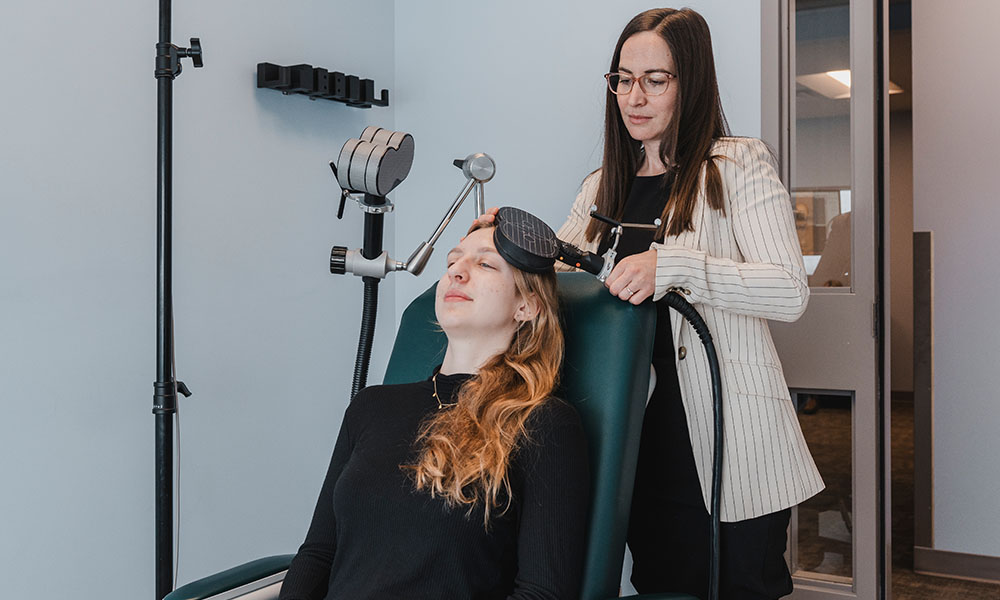
rTMS acts by directly stimulating specific brain circuits known to be involved in depression. This is done by producing a brief magnetic field applied directly over the scalp to modulate brain activity. When delivered repeatedly over time, this treatment can change the activity of brain circuits through a process called neuroplasticity. It has demonstrated clinically meaningful effectiveness for individuals who have not responded to first-line treatments such as medication or psychotherapy, with response rates of approximately 50% and minimal associated side effects. Treatment does not require anesthesia or post-procedure recovery time.
At The Royal, rTMS is offered through an integrated program that provides both clinical care and research opportunities for individuals experiencing unipolar depression.
A single referral process is used for both pathways. During your consultation, one of our psychiatrists will discuss the available options and help determine the most appropriate pathway for your care.
Treatment made possible by research
Alongside clinical service delivery, our Neuromodulation Research Clinic conducts research, innovation, and evaluation activities to better understand who benefits most from treatment, develop more personalized approaches to care, and continuously improve patient outcomes.
